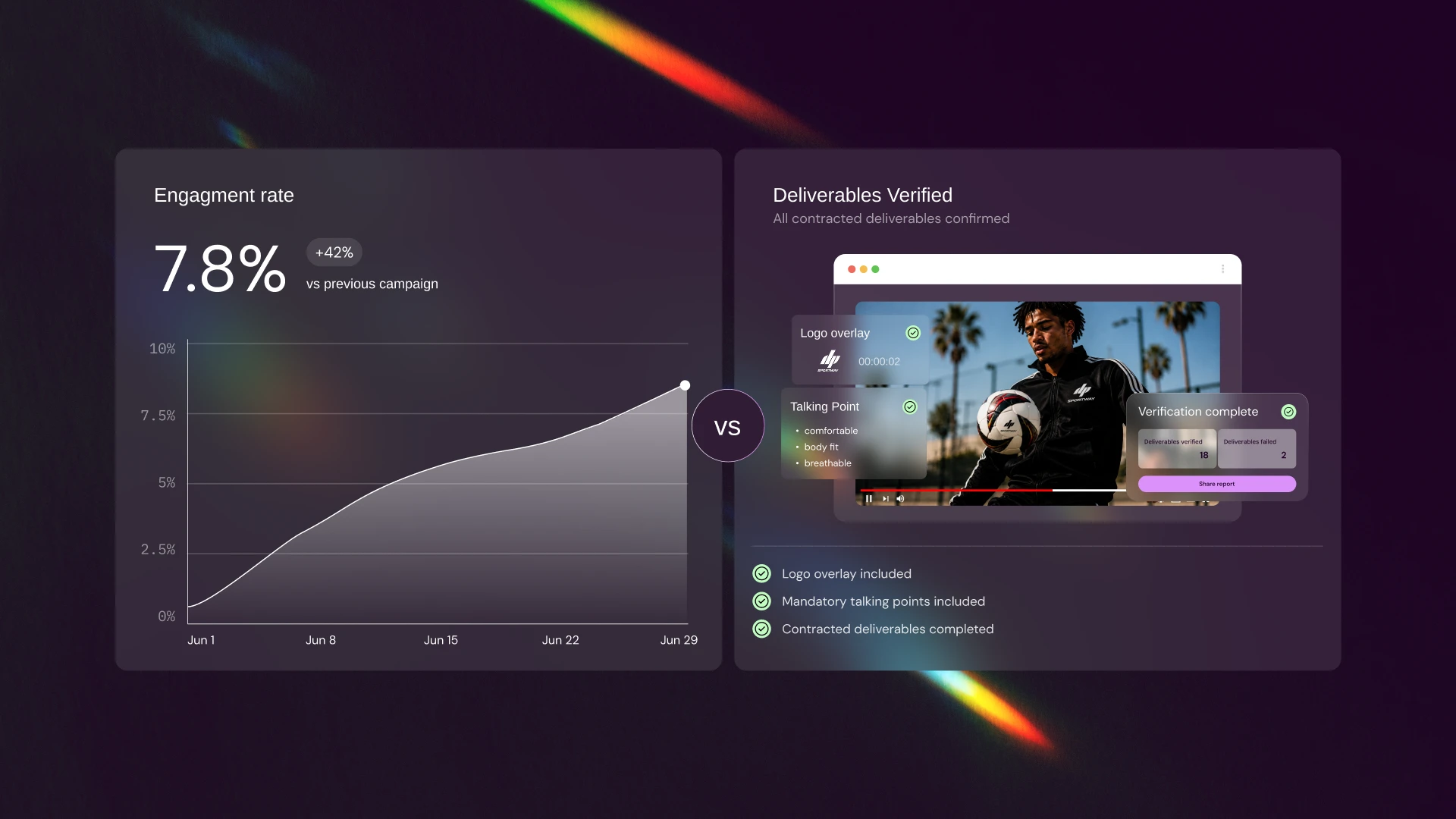

A campaign can post strong numbers and still fail the brand it was built for. Not because the creator underdelivered. Not because of fraud. Simply because the number everyone was watching was the wrong one.
Engagement rate became the default scoreboard for creator marketing because it was easy to access, easy to compare and available almost immediately. But as creator marketing budgets and expectations have grown, the limits of that metric have become increasingly difficult to ignore. A high engagement rate tells you that people interacted with content. It does not tell you whether the brand was communicated correctly, whether the agreed deliverables were completed, or whether the campaign created meaningful brand impact.
And those are increasingly the questions that matter.
What engagement rate actually tells you
Engagement rate measures audience interaction: likes, comments, shares and other platform actions.That information still has value. It tells marketers something about how audiences reacted to a piece of content.
But engagement was never designed to answer the broader questions brands increasingly expect campaign reporting to answer.
- Was the integration visible?
- Did the creator follow the brief?
- Was mandatory wording included?
- Did viewers engage with the brand message?
- Did the campaign strengthen awareness, consideration or intent?
An interaction with a post cannot answer those questions on its own. The problem starts when engagement rate stops being treated as an interaction metric and begins acting as a proxy for overall campaign success.
High engagement and real brand impact are often two separate things.
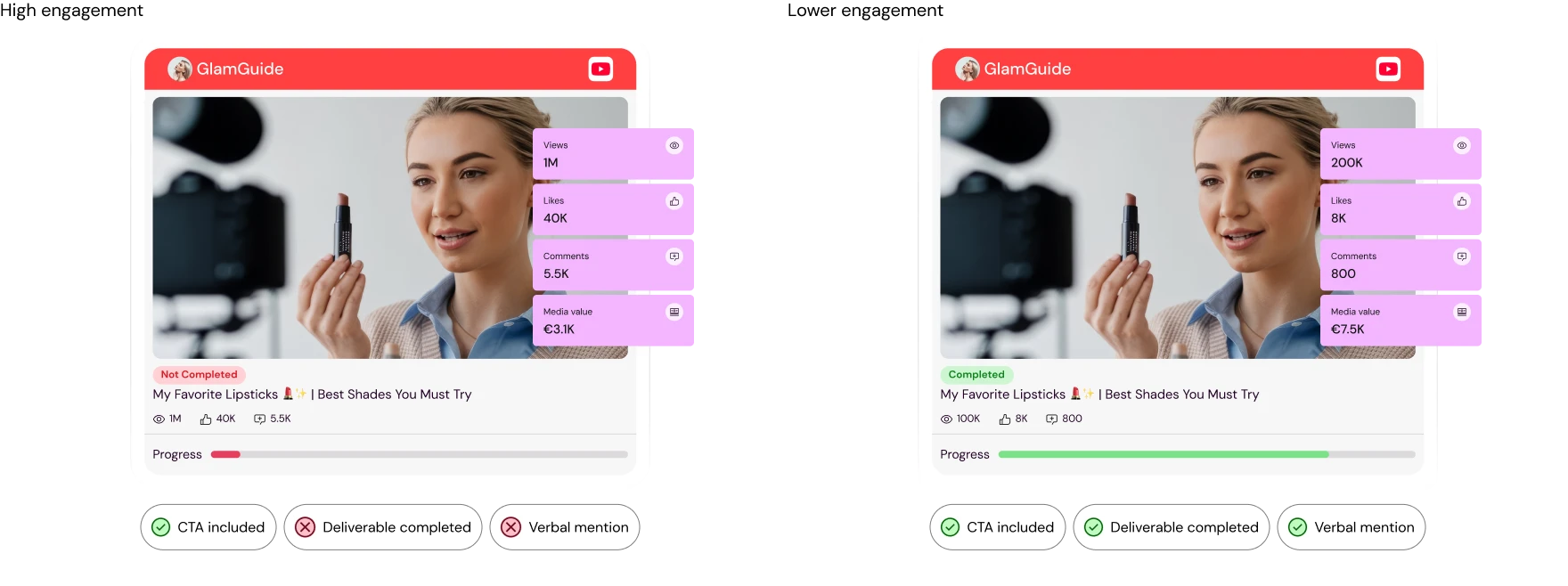
Engagement does not equal brand impact
The gap between engagement and actual impact is not theoretical.
- Kantar's analysis of more than 15,000 branded creator assets across TikTok, Instagram and YouTube Shorts found that only 6% delivered both strong engagement and measurable brand-building impact (Kantar, 2026).
- Even when the threshold is widened, the relationship remains weak - only 27% of the content studied combined medium-to-high engagement with medium-to-high brand impact (Kantar, 2026).
- Proving return remains one of the industry's biggest unresolved challenges: 79% of marketers identify determining ROI as their biggest challenge in influencer marketing (Linqia research, cited by eMarketer).
Together, those figures point to the same issue: creator marketing has spent years optimizing for the metric that is easiest to see rather than the outcome a campaign was ultimately supposed to deliver.
Why engagement rate became the default
If engagement rate has clear limitations, why does it still sit at the top of so many campaign reports? Because it solves several operational problems extremely well.
Speed: Engagement data is available almost as soon as content goes live. It fills the reporting gap before more meaningful campaign analysis has taken place. That speed makes it useful - but it also encourages teams to confuse immediate availability with strategic importance.
Easy access: Every major platform provides engagement metrics directly. There is no brief to analyse, no content verification layer and no additional measurement process required. The number is already there, which makes it the easiest metric to place into a report.
False comparability: Because almost every campaign produces some form of engagement rate, the metric appears standardized. But comparability does not automatically mean accuracy.
.webp)
Why engagement rate became the default
If engagement rate has clear limitations, why does it still sit at the top of so many campaign reports? Because it solves several operational problems extremely well.
Speed: Engagement data is available almost as soon as content goes live. It fills the reporting gap before more meaningful campaign analysis has taken place. That speed makes it useful - but it also encourages teams to confuse immediate availability with strategic importance.
Easy access: Every major platform provides engagement metrics directly. There is no brief to analyse, no content verification layer and no additional measurement process required. The number is already there, which makes it the easiest metric to place into a report.
False comparability: Because almost every campaign produces some form of engagement rate, the metric appears standardized. But comparability does not automatically mean accuracy.
Engagement rates cannot be compared blindly across platform
A 5% engagement rate on one platform does not necessarily mean the same thing as a 5% engagement rate somewhere else.
Platforms encourage different behaviours. Their interfaces, content formats, audiences and engagement mechanics differ. Even the way engagement rates are calculated can vary depending on whether the denominator is followers, impressions, views or reach.
.webp)
Same label. Different context.
Yet these numbers are frequently placed side by side inside campaign reports as though they were directly equivalent, creating an illusion of precision. A creator can appear to outperform another simply because of how the platform generates and calculates engagement - not because the content delivered more value for the brand.
This is why engagement rate can still be useful within the right context, but becomes unreliable when treated as a universal benchmark for campaign effectiveness.
What modern campaign measurement should focus on
The solution is not another engagement-rate formula. It is changing the order in which campaign performance is evaluated.
Before asking how audiences reacted, brands first need to know whether the campaign actually delivered what was agreed. That means verifying specific, observable elements of the creator content against the original brief:
- Whether the agreed content was published
- Whether the required brand message appeared
- Whether visual integrations were visible as agreed
- Whether all talking points were covered
- Whether mandatory wording was included
- Whether placements appeared in the correct context
- Whether all contracted deliverables were completed
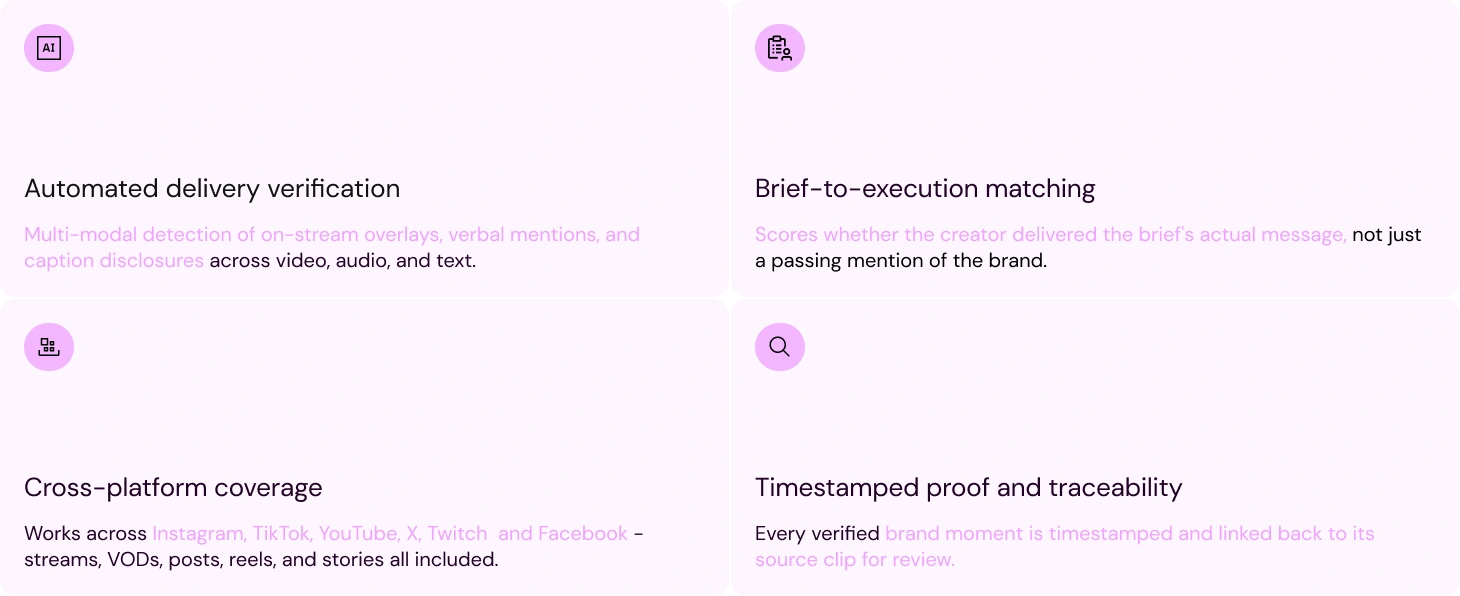
These questions sound basic. But platform analytics cannot answer them on their own. Doing that properly means analysing the content itself - spoken audio, titles, captions, commands & bot messages, chat messages) and other deliverbales like hashtags and mentions - and comparing those elements against what the campaign brief actually required.
Verification should come before performance scoring
Consider two creator posts. Both may generate an engagement rate of 7%.
The first includes the required brand message, CTA, mandatory wording and agreed placement. The second misses the mandatory wording, skips the required talking points and fails to communicate the campaign's key message.
From a platform analytics perspective, they may look almost identical. From a campaign-delivery perspective, they are completely different.
Platform analytics show how people reacted. Verification shows what the brand actually received.
Both matter. They simply measure different parts of campaign performance. Engagement can help explain audience response after content has gone live. Verification establishes whether the campaign itself was executed correctly in the first place. That distinction becomes increasingly important as creator programs scale across more creators, markets, formats and platforms.
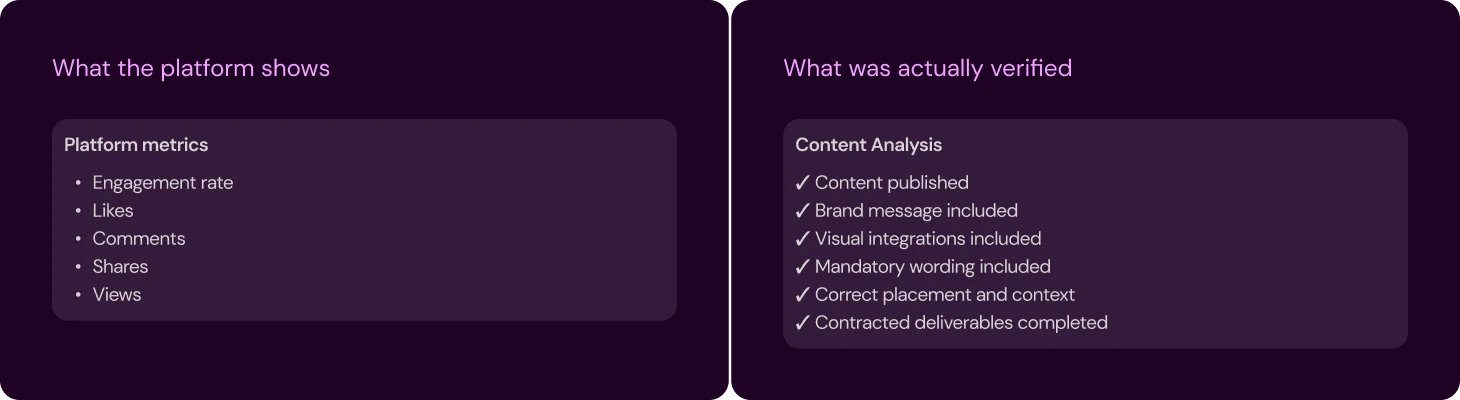
From proxy metrics to campaign intelligence
The next stage of creator marketing measurement is not about removing engagement from reports. It is about putting engagement back into the right position.
Instead of asking “Did this post get a good engagement rate?”, campaign teams can ask “Was the agreed campaign delivered correctly, how was the brand actually represented, and how did audiences respond once that delivery was verified?” That produces a much more complete performance picture.
This is the shift verification-first campaign measurement is designed around: moving from easily available proxy metrics toward evidence of what actually happened.
The bottom line
Engagement rate is not wrong. It simply answers a much smaller question than many reporting decks pretend it answers. It can show whether people interacted with a piece of content. It cannot, by itself, tell a brand whether the campaign was executed correctly, whether the agreed message was delivered or whether strong platform activity translated into meaningful impact.
The industry's own research increasingly reflects that distinction. Strong engagement and real brand impact overlap in only a small proportion of branded creator content. For brands, agencies and campaign teams, the implication is clear.
Stop treating engagement as proof of success. Start by verifying what was actually delivered. Then measure the reaction.
Get new insights straight to your inbox
Don’t miss out on the insights that the press and media rave about!