
Most creator campaign reports answer a question nobody asked. They tell you how many people saw a post. They rarely tell you what the post actually said, showed, or delivered against the brief. That gap, between activity and delivery, is where the conversation about “good” reporting should start.
The report that isn't a report
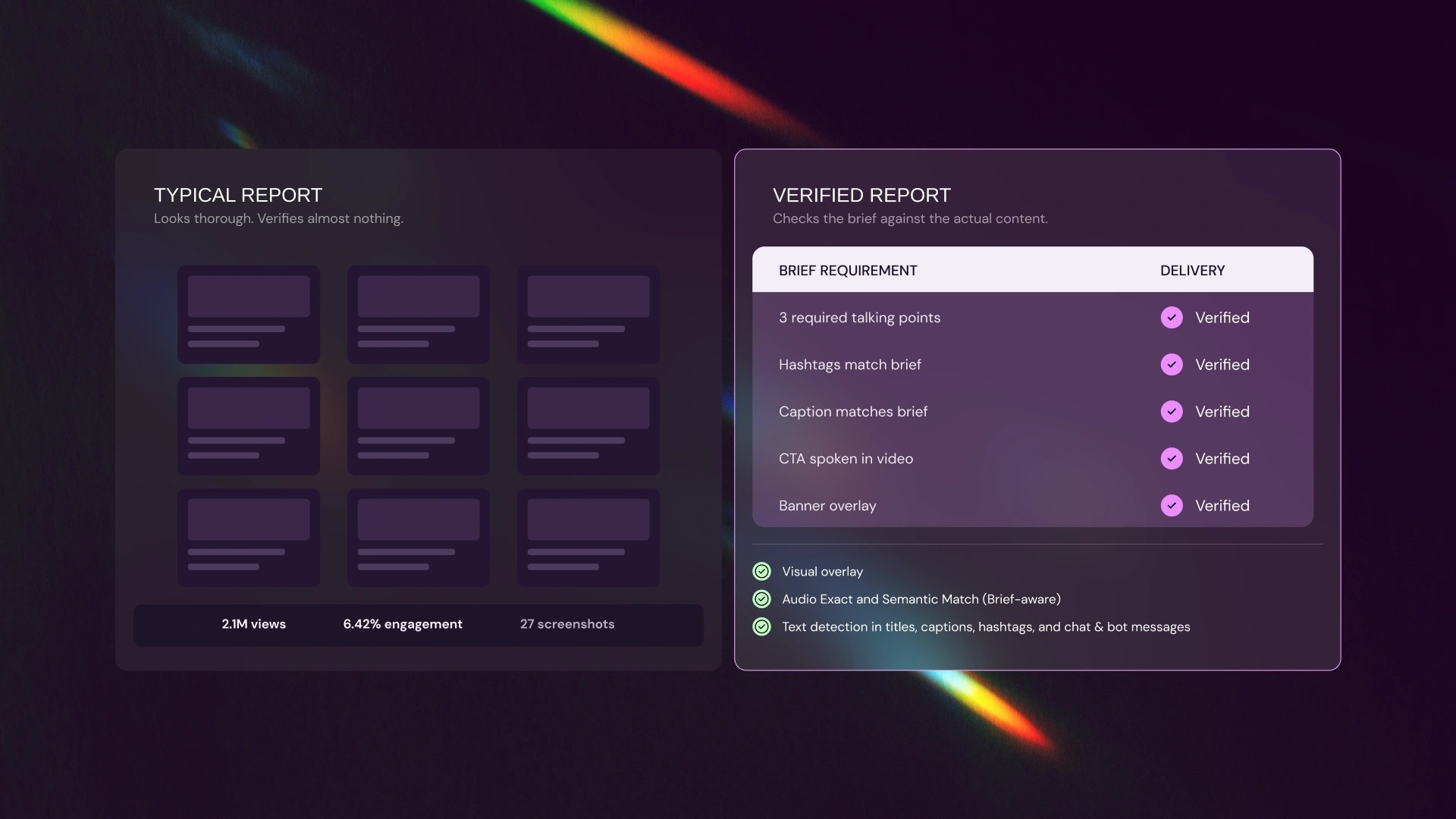
Open a typical end-of-campaign report and you'll find a familiar shape: a grid of screenshots, a column of view counts, an engagement rate rounded to two decimal places, and a paragraph of narrative stitched together after the fact. It looks thorough. It rarely says whether the creator actually mentioned the three required talking points, held up the product for the specified duration, or used the approved on-screen text.
A report that can't confirm what was actually talked about in a video or stream isn't a report. It's a summary of what the platform happened to share.
That distinction matters more as budgets grow. A single creator partnership can survive on trust and a screenshot. A program running across dozens of creators and several platforms cannot, because nobody has time to manually check each video against the brief, and reports that skip this step simply don't catch what went wrong until a client or a brand safety review asks a question the team can't answer.
What “good” actually requires
Reporting that holds up under scrutiny tends to share three traits, regardless of the platform or the size of the program.
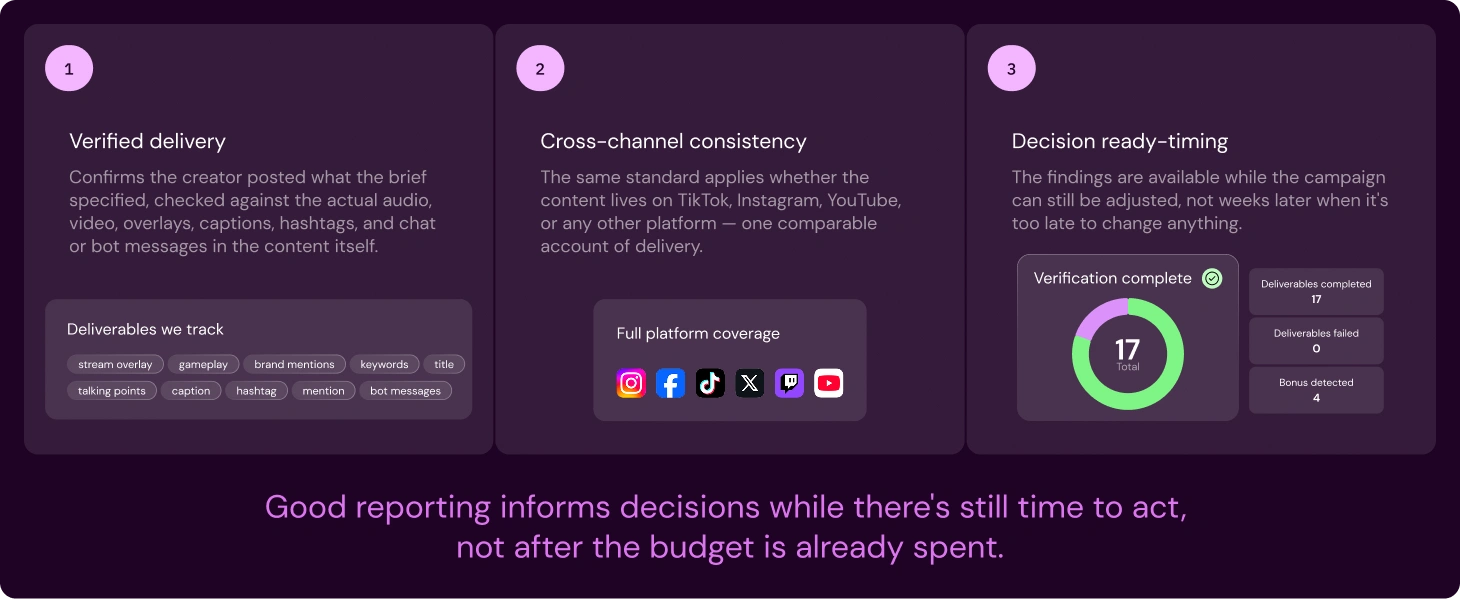
- Verified delivery: The report confirms the creator posted what the brief specified, checked against the actual audio, video, on-screen text, and logo overlay in the content itself, not just a link, a screenshot, or a self-reported confirmation from the creator.
- Cross-channel consistency: The same standard applies whether the content lives on TikTok, Instagram, or YouTube, so a campaign spanning six platforms produces one comparable account of delivery, not six incompatible dashboards.
- Decision-ready timing: The findings are available while the campaign can still be adjusted, not three weeks later when the budget has already been spent and the only remaining use for the report is filing it away.
None of this is exotic. It's closer to how sponsorship and media buys have been measured for decades: what ran, where, in what form, checked against what was paid for. Creator marketing has mostly skipped that step, relying instead on whatever the platform's own analytics panel happens to expose.
Why platform metrics keep filling the gap
Platform dashboards are convenient and free, which is exactly why they became the default reporting layer for an industry that grew faster than its measurement practices. Views, likes, and shares are easy to pull. Confirming that a creator's video actually matched the brief takes watching it, and watching hundreds of videos per campaign doesn't scale on a spreadsheet.
So teams reach for proxies instead: a promo code redemption, an affiliate link click, a native shop tap. These are useful signals. They are not the same thing as knowing what was delivered, and treating them as interchangeable is how a report ends up confident about the wrong question.
The scale of the gap
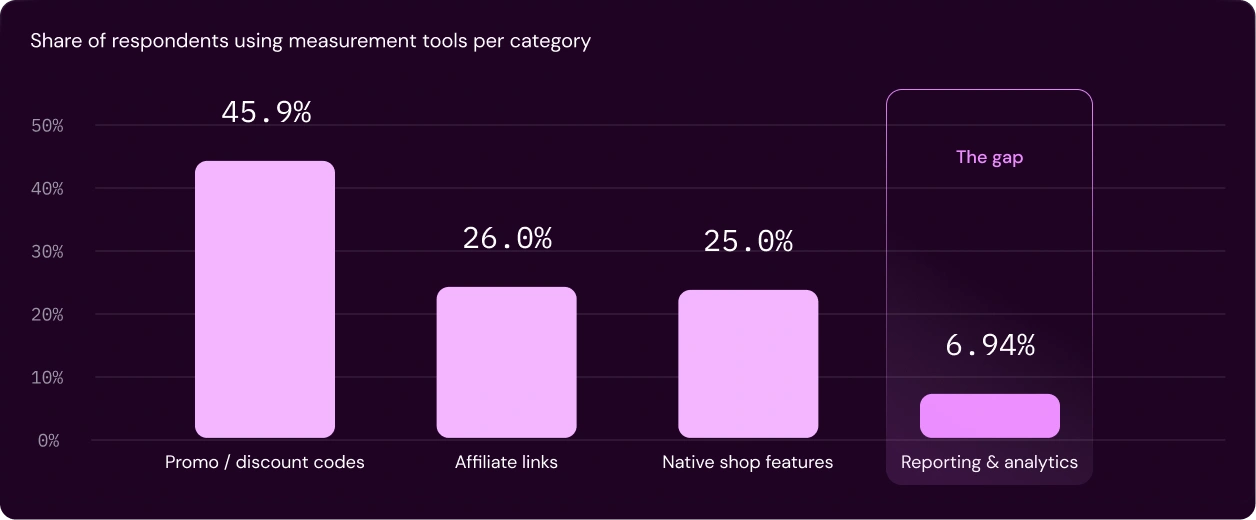
A few figures put this in perspective. In the Influencer Marketing Hub's 2026 Benchmark Report, promo and discount codes are the most widely used measurement tool, adopted by 45.9% of respondents, ahead of affiliate links (26.0%) and native shop features (25.0%), all indirect proxies for what actually happened in the content itself.
The same report finds that measuring ROI and attribution complexity together account for 15.84% of the challenges brands report facing, while reporting and analytics is the single least outsourced function in the industry at 6.94%, meaning most brands keep this work in-house even as they work to do it well. Meanwhile, creator ad spend is projected to reach $44 billion in 2026 (Marketing Dive, 2026), a pace of growth that is not matched by a comparable jump in how rigorously that spend gets checked.
What this looks like in practice
The tools built for creator marketing so far have mostly focused on the stages before delivery: finding creators, managing relationships, handling contracts and payments. That's valuable work, and it's a different job from confirming what shipped matches what was briefed. Discovery and CRM platforms answer “who should we work with.” Verification answers “did they do what we asked.”
The industry has plenty of tools for finding creators and paying them. It has far fewer for confirming what they actually posted matched the brief.
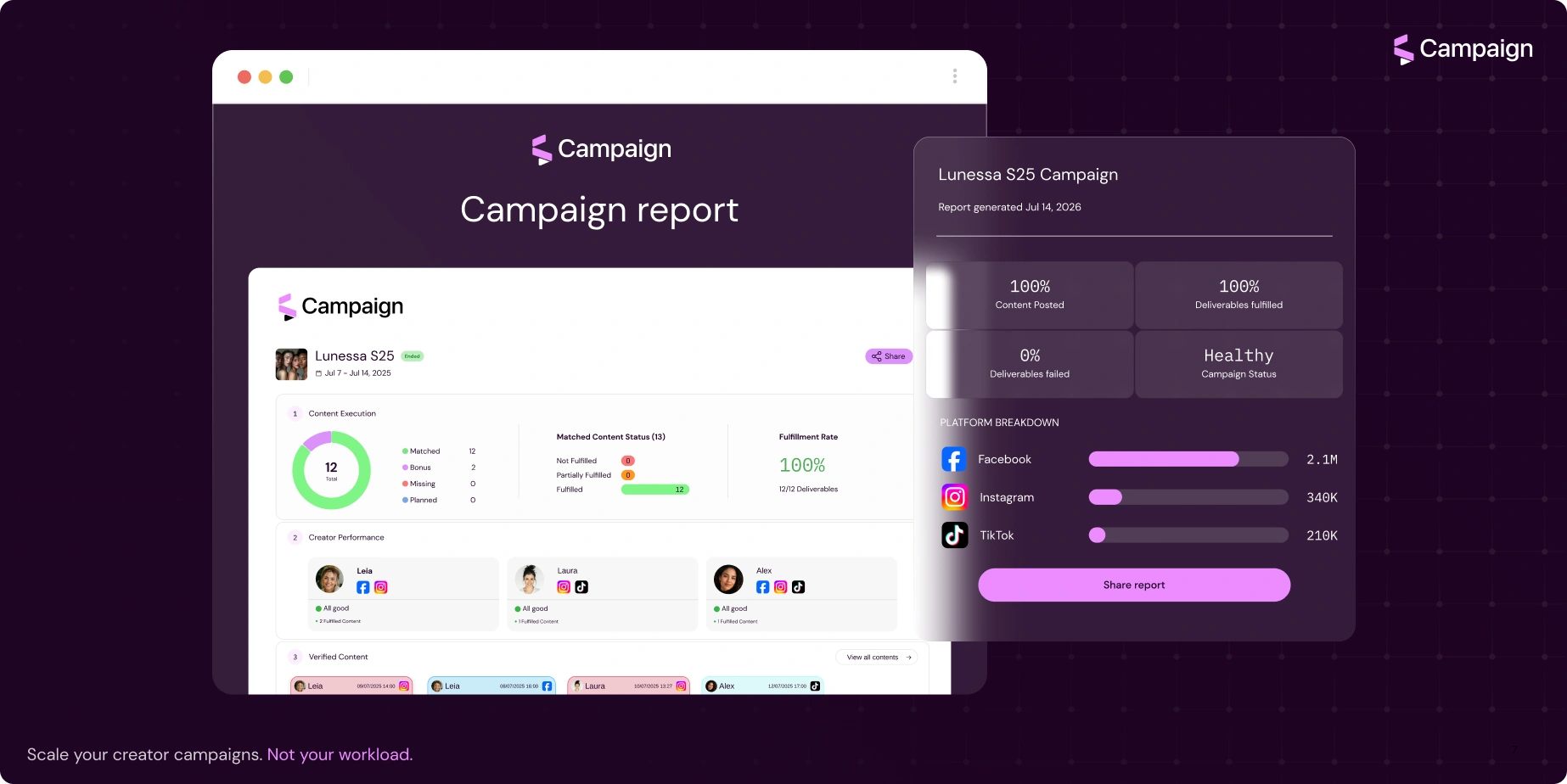
Shikenso Campaign was built around that second question specifically: checking the audio, video, on-screen text, and logo overlay in what a creator actually delivered against the brief, rather than reading platform metrics as a stand-in for delivery. That's a narrower job than a full creator marketing suite, and it's the piece that most reporting today quietly skips.
Good reporting, in the end, isn't a bigger dashboard or a longer PDF. It's an honest, checkable account of what actually happened, delivered while it can still change the outcome. Everything else is decoration around a question the report never actually answers.

Get new insights straight to your inbox
Don’t miss out on the insights that the press and media rave about!